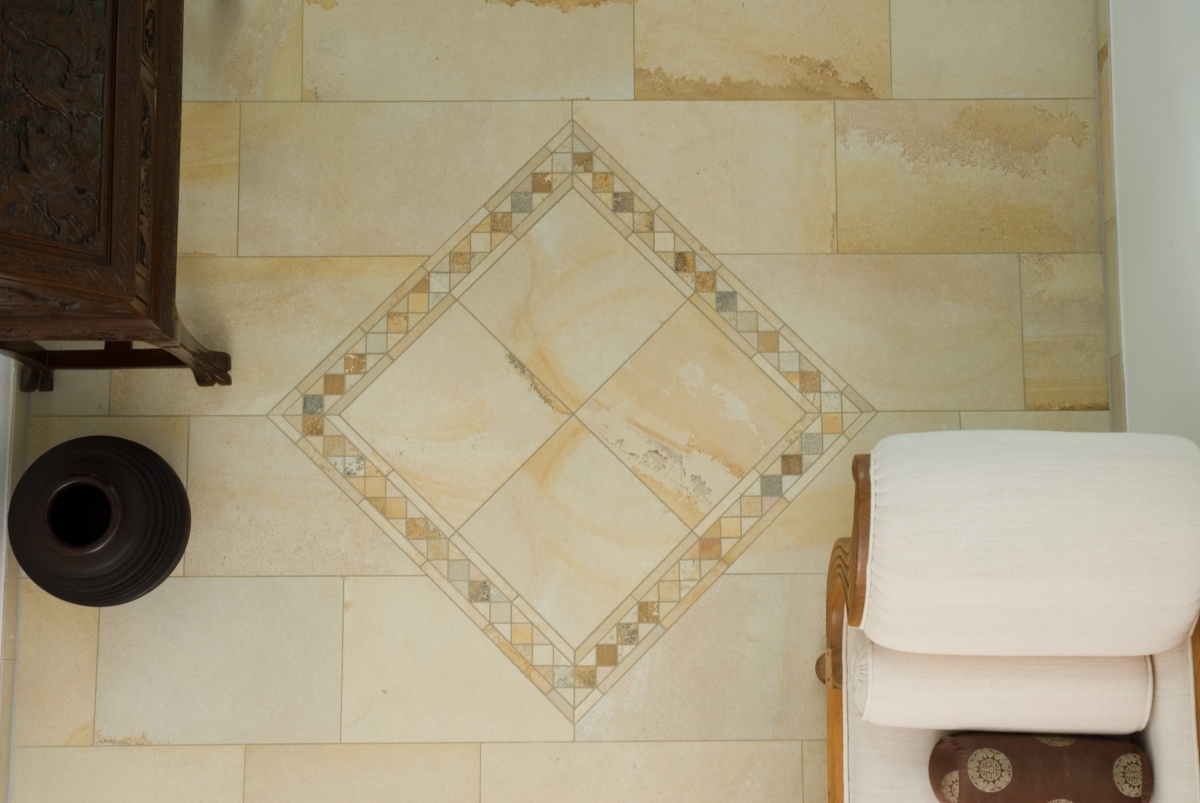
Why pH matters for stone cleaning
Natural stone flooring divides into two broad chemical categories when it comes to cleaning compatibility: silica-based stones and calcium-based stones.
Granite, quartzite, and slate are silica-based. The primary minerals — quartz, feldspar — are stable across a wide pH range. These stones tolerate mild acids and mild alkalines without surface damage in normal household cleaning concentrations.
Marble, limestone, and travertine are calcium-based. Their dominant mineral is calcite (CaCO₃), which reacts with acids through a straightforward chemical process: the acid dissolves the calcium carbonate, leaving a dull, etched surface. This is not a polish scratch — it is a chemical change to the stone's crystal structure, visible as a hazy or matte patch on an otherwise glossy surface. Etching cannot be removed by cleaning; it requires mechanical honing to restore.
The consequence for cleaning products in Poland is direct: most supermarket floor cleaners, bathroom cleaners, anti-scale sprays, and multi-surface products contain acidic ingredients (citric acid, hydrochloric acid, acetic acid) and should not be used on calcium-based stone. The products available in Polish retail chains — Biedronka, Lidl, Rossmann, Drogerie Markt — are generally not labelled for stone compatibility.
Hard water and Polish stone floors
Poland's municipal water supply varies by region, but most urban areas have moderately to highly hard water. Sanepid (Główny Inspektorat Sanitarny, the Chief Sanitary Inspectorate) publishes periodic water quality reports for Polish municipalities. Warsaw's water supply, drawn primarily from the Vistula and Zegrze reservoir, consistently registers between 15 and 25 dH. Kraków's water from Dobczycki reservoir is similarly in the 14–20 dH range. Poznań and Wrocław typically measure above 20 dH in most distribution zones.
Hard water leaves calcium and magnesium deposits on stone surfaces as it evaporates after mopping. On polished marble or limestone, these deposits appear as a whitish haze that builds up over time and dulls the stone's reflectivity. On travertine, minerals can also accumulate inside open pores.
Managing hard water residue
The approach depends on the stone type:
- On granite: commercially available lime scale removers can be applied carefully in a diluted form. Alternatively, diluted white vinegar (approximately 1:10 in water) will dissolve calcium deposits without damaging the stone.
- On marble, limestone, travertine: acidic descalers must not be used. Instead, use a dedicated pH-neutral stone cleaner followed by thorough rinsing with soft water or a diluted distilled-water mix. For heavier deposits, a professional stone restoration product from suppliers such as Fila, Mapei, or Tenax should be consulted.
Several regions in Poland have begun offering filtered or softened municipal water in new residential developments, but this is not yet widespread. Building-level water softeners are available for installation in Polish apartment blocks, though their installation requires agreement from the building management (wspólnota mieszkaniowa).
Routine cleaning: what works for each stone type
Daily or every-other-day: dry removal
The most damaging routine action to polished stone floors is grinding grit underfoot. In Poland's climate — with sand spread on roads and pavements in winter, and construction dust prevalent in many urban and suburban areas — tracking in abrasive particles is difficult to avoid. A microfibre dry mop used daily in entrance areas and high-traffic zones removes this grit before it can scratch the surface. This step has more impact on a polished marble floor's long-term appearance than any wet cleaning product.
Weekly wet mopping: marble, limestone, travertine
- Use a pH-neutral stone cleaner diluted in warm water as per the product instructions
- Wring out the mop thoroughly — excess water pooling on stone, especially in tile joints, can cause grout damage over time
- Rinse the floor with clean water after mopping if the cleaner leaves residue (some products require this step)
- Allow the floor to dry without pooling — in bathrooms, ventilation after mopping helps
Weekly wet mopping: granite
- Granite tolerates a wider range of cleaners; a standard neutral floor cleaner at correct dilution is suitable
- Avoid using oil-based cleaners or wax products that can leave a film reducing traction, particularly in bathrooms
- In kitchens, degreasers with a mildly alkaline pH (up to approximately 9) are suitable for granite and will not damage the surface
Seasonal considerations in Poland
Autumn and winter: road grit and mud
Polish local authorities spread sand and calcium chloride (CaCl₂) on roads and pavements during winter freezing conditions. Calcium chloride tracked indoors dissolves in water and can leave residue on stone floors. On calcium-based stones, this is generally not a chemical problem — the chloride is a neutral salt — but the grit tracked in simultaneously is an abrasion risk. Entrance mats with coarse fibres placed inside and outside exterior doors significantly reduce the amount of winter grit reaching stone floor surfaces.
Spring: transition from heating season
As heating systems reduce output in spring, indoor humidity rises. This is also the period when construction-related dust is more common (renovation season intensifies in March–May). A deeper cleaning in late April or May — using stone-appropriate cleaner at a slightly higher concentration — removes the accumulated film from the heating season and prepares the surface for sealant inspection and possible resealing.
Summer: maintenance at ambient humidity
Summer is the recommended period for sealing or resealing stone floors. At ambient temperatures of 18–25°C and normal indoor humidity, penetrating sealants cure within the manufacturer's stated time. Applying sealant during the heating season, when indoor humidity is very low, can cause some sealant types to cure too quickly, reducing penetration depth.
Products to avoid on natural stone floors in Poland
| Product type | Risk | Affects |
|---|---|---|
| Acidic scale removers (Domestos Scale, Sidolux Antyosad) | Etches and dissolves calcite surface | Marble, limestone, travertine |
| Vinegar-based cleaners | Etches calcium-based stone on contact | Marble, limestone, travertine |
| Bleach-based cleaners | Can bleach out natural colour variation | All stone types |
| Abrasive powder cleaners | Scratches polished surfaces | All stone types |
| Wax-based floor polishes | Build-up reduces traction; requires stripping | All stone types |
| Alkaline degreasers above pH 10 | Can dissolve grout, weaken sealant layer | All stone types |
Spill response on different stone types
Speed of response matters more than the cleaning product used for most spills. On sealed stone, a liquid spill absorbed within the first minute or two is significantly less likely to stain than one left for twenty minutes. On unsealed or thinly sealed stone, absorption can begin almost immediately.
The standard approach is to blot (not wipe) the spill with an absorbent cloth, then clean the area with the appropriate product for the stone type. Wiping spreads the liquid; blotting removes it. For wine, coffee, and olive oil on marble or travertine, a paste poultice — made from baking soda and water applied over the stain and covered with cling film for twelve to twenty-four hours — draws out the absorbed stain through osmosis as it dries. This method works reasonably well for fresh stains and is preferable to applying chemical cleaning products that may damage the stone.